Showing posts with label Science. Show all posts

Nov 24, 2009

Bill Bryson's Notes From a Large Hadron Collider

I have been obsessed with Bill Bryson's books for the last several months, so occasionally I'll enter his name into the Google News search engine and see what's happening with the country's favorite travelogue writer from across the pond-slash-Iowa. Today I found the following morsel of writing.

From The Times Online:

In the event that it fell to you to identify the most exciting place on the planet, the likelihood is small, I imagine, that you would pack a bag and travel at once to Switzerland. Still less, I dare say, would you turn your back on Geneva and head out past its western suburbs and into the pleasant but uneventful countryside beyond. There, in a broad valley shared with France, stands a collection of buildings that look like the leftovers from a 1960s Festival of Bad Design.

This is it. You have found it. This is CERN, the European Organisation for Nuclear Research. Over the next few days the people who run the place will cautiously restart the immensely large machine (almost 27 kilometres around) known as the Large Hadron Collider and begin swooshing particles around it in a way that will, when it is fully humming, recreate conditions as they were in the Universe one millionth of a millionth of a second after the beginning of the big bang.


Read the entire article here.

Nov 7, 2009

Lightning May Contain Anti-Matter


From Science News:

Designed to scan the heavens thousands to billions of light-years beyond the solar system for gamma rays, the Fermi Gamma-ray Space Telescope has also picked up a shocking vibe from Earth. During its first 14 months of operation, the flying observatory has detected 17 gamma-ray flashes associated with terrestrial storms — and some of those flashes have contained a surprising signature of antimatter.


What is Antimatter? I'm not really sure. But according to Wikipedia,

In particle physics, antimatter is the extension of the concept of the antiparticle to matter, where antimatter is composed of antiparticles in the same way that normal matter is composed of particles. For example, an antielectron (a positron, an electron with a positive charge) and an antiproton (a proton with a negative charge) could form an antihydrogen atom in the same way that an electron and a proton form a normal matter hydrogen atom.


It reminds me of the music scale, where an A# (A-sharp) is also a Bb (B-flat), except antimatter is much more complicated.

[SIGNATURE OF ANTIMATTER DETECTED IN LIGHTNING]
[Antimatter]

A Letter on Evolution: The 'Religion' of Evolution


My growing fascination with the way we use language, and indeed how it changes, is the impetus behind posting this video...and also its message, I admit.

Language is indeed very powerful and yet something which changes frequently. In microscopic steps, it seems sometimes. An entire debate can hinge - as often the evolution debate does - on semantics, on whether people "believe" in evolution.

And yet, this is how scientists are "losing" this "debate". It's really a non-debate, and scientists aren't losing the debate. They're losing the PR battle. Every year - I won't say every day, though this distinction may be accurate - new evidence solidifying the relative truth of evolution is revealed (as much as anything can be "true").

This is the place where the rub happens. Scientists believe - there's that word again - that nothing can be known in an absolute way. It is not belief, as the video suggests, in a blind sort of way. So that's why there is a "debate".

I could, if I had the time and patience and desire, begin to dispute any number of scientific realities and end up turning the tide on them. That may sound arrogant, but it's not. It's a disparity between the way the two camps discuss the issue. I am no more capable than anyone (who is not a scientist) of disproving scientific data, but since I realize that disputing something in today's world creates a "debate", then I am already halfway to the point of converting people to my side.

Creationists/IDers are just the same as the PR folks who work for cigarette companies. They hire (Read: pay) scientists to say that "there is no known link between cigarettes and cancer". And there are people who say that trans fats actually clear arteries, rather than clog them. That Elvis is still alive. That George Bush was responsible for 9/11.

Oct 29, 2009

An Age When Facts Are Irrelevant


Have we reached an age in which facts are of no consequence? Nature.com has posted an article which has sparked my interest on the subject, and one of its premises is this: The assumption is that if they [scientists] explain things very, very clearly, everyone will understand. Unfortunately, this is an uphill battle.

The painfully unenlightened dialogue on the relative truth of scientific claims - we can never really "know" something - has digressed even farther, to the point that people, when confronted with evidence of an overwhelming variety, are able to appeal to belief in order to circumvent what has been said.

A consequence of being so surrounded by technology and knowledge is that we are free to disregard or contradict or subvert any claim with which we do not agree. Even the most uneducated person in America, with a desktop and an internet connection, can find corroborating evidence to support their beliefs, and this notion is specious and, in the end, unscientific. It is a gross misunderstanding of skepticism and thus deserves contemplation.

See, for example, I may believe that the Holocaust never happened. I may also believe that the events of the 'Iliad' never happened, either. Both are historical events, and I can only trust that both happened based on historical accounts, or available evidence. One glance at a photograph from Auschwitz will certainly convince any number of credulous people. Reading an account of an Auschwitz survivor depicted in one of the aforementioned photographs may convince slightly more skeptical people.

At this point, people may be able to still hold a certain amount of skepticism. If a picture and a few firsthand accounts were all we had, then we may feasibly doubt the existence of the Holocaust. It is certainly for that reason that people are unsure of the veracity of the war that is at the center of the 'Iliad'. The accounts are centuries behind the supposed events, so we are confident that we can discredit its actual happening.

The same is not true with the Holocaust. We do not have scant evidence for Hitler's persecution of the Jews, nor do we have very much wiggle room with regard to its truth, and yet people still do insist that the Holocaust either did not exist or was greatly exaggerated, despite the mounds upon mounds of evidence we have to prove otherwise.

I've taken a long detour here, but I'm getting back to my point. Let me, then, ask a question: Are Holocaust deniers mere skeptics? Are they even skeptics at all? How free am I to believe what I wish? Being on the other side, am I a member of the intellectual Gestapo if I insist that beliefs of an unfounded nature are simply unacceptable to hold in today's world? At what point do we stop accepting this kind of half-assed thinking? Is truth, as we experience it, really that malleable?

I do not mean to make a Straw Man out of the Holocaust deniers (though I think that few people would object to me ridiculing them), so let me move onto another subject: ghosts. Spirits. Poltergeists. Whatever you call them, there is a significant amount of observational evidence for their existence, and yet very little empirical, scientific evidence supports that the door that will not stay open in your grandmother's home has anything to do with the four people who were butchered there fifty years ago.

Most rational people reject the existence of ghosts, though, sight unseen. The white dots and inexplicable shadows on photographs do not point immediately to the idea that Uncle Bernie has come back in that form to...well, haunt a photograph. It's because the burden of proof is on the ghost hunters to make it so, and electromagnetic fields and dotted pictures do not pass snuff, just as random alignments of data do not point to the world ending in December of 2012.

The problem is that armchair skepticism has become the normal mode of expression of doubt in this country, and people are able to comfort themselves in constantly moving back the uprights on matters of evidence. Skeptics of evolution say that there are no "transitional" fossils in the record, using science's own language against it, and no matter how many actual, true transitional fossils scientists are able to haul out, people claim to have never seen them.

Perhaps it is because the science has outraced the common intellect. Scientists of two hundred years ago could be scientific hobbyists, and most people could identify with the claims being made and accept the facts because the facts were more or less the result of a thought experiment backed up with science and common sense. It's how we came to understand gravity, the lunar cycle, etc. Science now is so far beyond a common person's understanding that, by comparison, ghosts seem quite easy to believe in.

This, I'm afraid, is a problem. The burden of proof is always on the one who posits a truth - this IS so - rather than those who reject it. You do not, for example, have to prove that there are no fairies in my garden if I say so, or that there is not a pink elephant in my trunk, even if I stomp up and down and shout furiously. It is up to me, at that point, to bring about the compelling evidence. I can find millions of people to agree that there are, indeed, fairies in the garden, or that the squeaking noise in my attic is the spirit of a Civil War soldier come to find his bayonet, or that the Holocaust was a primitive and very successful Photoshop campaign, but if I cannot provide substantive scientific evidence to support my claims, then I really have no claim to proof.

[img source=Paul Gaugin - Don't Listen to the Liar]

Oct 1, 2009

'Ardi' Fossil Revealed - Oldest Known Hominid


An international team of researchers has revealed the remains of the oldest known hominid in existence, nicknamed Ardi due to its name (Ardipithecus ramidus).

The details can be found in the Science journal:

Researchers have unveiled the oldest known skeleton of a putative human ancestor--and it is full of surprises. Although the creature, named Ardipithecus ramidus, had a brain and body the size of a chimpanzee, it did not knuckle-walk or swing through the trees like an ape. Instead, "Ardi" walked upright, with a big, stiff foot and short, wide pelvis, researchers report in Science. "We thought Lucy was the find of the century," says paleoanthropologist Andrew Hill of Yale University, referring to the famous 3.2-million-year-old skeleton that revolutionized thinking about human origins. "But in retrospect, it was not."


Scientists urge, though, that we not jump to conclusions. Some, among them David Pilbeam, think the chimpanzee and Ardipithecus ramidus did not evolve in a mutually exclusive manner: "I find it hard to believe that the numerous similarities of chimps and gorillas evolved convergently." We have no evidence that Ardipithecus gave way to Australopithecus, and more tests will have to be done to discover what exactly occurred. But still, this is a HUGE find!

[Ancient Skeleton May Rewrite Earliest Chapter of Human Evolution]
['Ardi,' Oldest Human Ancestor, Unveiled]

Sep 25, 2009

Hammer and Feather Drop on Moon


The idea that, given ideal conditions, a hammer and feather would drop at the same rate in a vacuum wasn't originally proposed with space exploration. As the video suggests, it happened hundreds of years before, with Italian thinker Galileo, who said that, due to a lack of air resistance, a hammer and feather would fall at exactly the same rate.

On the Berto: Philosophy Monkey blog, the proposal is illustrated more in-depth:

He argued, contra the Aristotelian model, that falling bodies of different weights (say, a feather and a hammer) should not fall at different speeds. Any differences, he thought, could be wholly attributed to air resistance slowing down the feather.


Now, trying to find a font of objective knowledge on the subject is futile, bordering on impossible, because the overwhelming majority of sites exploring the thought experiment are dedicated to entirely debunking it (and the idea that we went to the moon in the first place). Including, I might add, the esteemed and highly reputable science source Wrestlingforums.net, as opposed, of course, to the highly reputable blog, Jinx Protocol.

Sep 23, 2009

Neil DeGrasse Tyson - On Intelligent Design


Neil DeGrasse Tyson can explain just about everything in easy-to-grasp terms. He's a natural communicator, as well as a brilliant scientist, and unlike plenty of other scientists, his astounding intelligence doesn't come off as smarmy or arrogant, which is a plus, in my book.

Here, Tyson discusses how the Universe is not here for our benefit. Indeed, it's about as hostile to humans as any place could be, give or take. I'm not sure if he goes into talking about the Earth - he talks plenty about the Universe as a whole - but the Earth's lack of habitable space is worth mentioning here.

People always talk about what an amazing fit humans and the Earth are, but they don't think of how little of the planet we are able to inhabit. It's a very small percentage, when discussed on the whole. It's not that being here at all isn't amazing. It is. It truly is, but that's just the point.

Plus, we live on an environmental knife-edge, where it is very likely for the balance to teeter in one direction or the other and cause the extinction of the entire human race, so our collective happiness should rest on the fact that we are here at all and not on just how much we mean to the rest of the Universe. Think about it like this: if the Earth was struck by a meteor the size of, say, Mt. Kilimanjaro, then we'd all be gone and the rest of the Universe would just keep plugging along.

Iguanas of the Galapagos Islands


The Richard Dawkins Foundation YouTube page has been uploading a series of videos featuring Richard Dawkins from around the world, explaining various examples of evidence for evolution. They are quite possibly in an effort to promote his new book, The Greatest Show on Earth, but it could also have been filmed as a result of research for the book itself.

Each video is only 2-3 minutes long and doesn't go into much depth, as far as evolutionary processes go, but the videos are wondrous in that they show species of animals that many of us will not see in our lifetimes.

Sep 21, 2009

Debunking ALL Scientific Illiteracy

Source: Brad Levin, cropped from linux-works

It's often the case that right-wingers are cited for their woefully half-baked pseudo-scientific claims, but celebrities and commentators on the left side of the aisle are often left alone for one reason or another. Hypocrisy is a bitter tonic, though, and so letting it slide from one source because we generally agree is just unacceptable as unfairly lambasting the opposing side.

As you've probably guessed from the content of the picture, today's subject is Bill Maher, who is as avid in his endorsement of "alternative" medicine as Jenny McCarthy is in denying children necessary vaccinations. Much of Maher's rantings about natural or alternative medicine can be dismissed with a singular eye roll, because it even seems to fall on deaf ears in the company of his guests and studio audiences, but he makes one dangerous claim (in the Overtime with Bill Maher segment) that really needs to be addressed. Namely, that cancer research has not gone anywhere in the last fifty years. He says:

"The shit we've tried for the last 50 years doesn't [work]. I know they've made no progress as far as cancer in this country. So, yes, there are people who actually go out of this country when they get cancer. Some of them come back alive after a death sentence. But in this country you can't talk about that. I might get arrested right now."


Science blogger Orac, on his blog, Respectful Insolence, discusses the point of cancer research at length:

Bill's other problem is a common one. Like all too many people, he appears to view cancer as one disease. It's not. In some cancers, we've made enormous progress in the last 50 years. For instance, most leukemias and lymphomas were death sentences 50 years ago. Now many of them are highly treatable and even curable. Lest you think that I'm cherry picking the easy, another example is colorectal cancer. For patients with metastatic colorectal cancer, for example, the time of survival and quality of life can both be significantly improved by the new generation of chemotherapeutic, antiangiogenic, and targeted therapies, as The Cheerful Oncologist pointed out two years ago.


I'm not a scientist, so I cannot speak to these claims with my own data, but I can research the hell out of this stuff if need be. Maher's problem - and I'm a big fan of him and Real Time, BTW - is that he, just like people on the other end of the spectrum, replace knowledge with belief and allow dogma to lead their thinking. Bill Maher believes that practicing alternative medicine (and getting rid of "toxins") is a viable option, rather than taking prescribed medications and listening to professionals. There really is little scientific evidence to support his claims about alt.med., but he states them as fact and impugns the very people who have made great advances in medicine over the last few decades.

Richard Dawkins's Wonderful Show


Tomorrow, September 22, marks the release of (sort of) controversial author Richard Dawkins's new book, The Greatest Show on Earth. The book, unlike his 2006 jeremiad The God Delusion, doesn't rail necessarily against organized religion. He seems to accomplished what he set out to do with that book.

Rather, Dawkins takes on the seemingly unnecessary task of highlighting the scientific evidence for evolution in the natural world. You would think there would be less resistance to these claims than the ones posited in God Delusion, but that's not necessarily the case. It seems as though his travels across the world - especially the U.S. - have made him quite pessimistic about the level of the average person's scientific literacy. A denial of evolution, based mostly on religious claims, is the central problem here. The review on Amazon explains it well:

He explains that all of his previous books have naïvely assumed the fact of evolution, which meant that he never got around to laying out the evidence that it [evolution] is true. This shouldn't be too surprising: science is an edifice of tested assumptions, and just as physicists must assume the truth of gravity before moving on to quantum mechanics, so do biologists depend on the reality of evolution. It's the theory that makes every other theory possible. Yet Dawkins also came to realize that a disturbingly large percentage of the American and British public didn't share his enthusiasm for evolution. In fact, they actively abhorred the idea, since it seemed to contradict the Bible and diminish the role of God. So Dawkins decided to write a book for these history-deniers, in which he would dispassionately demonstrate the truth of evolution beyond sane, informed, intelligent doubt.

Sep 20, 2009

Absurdist Lit. May Make You Smarter


Source: H.-P.Haack

Think that Kafka's 'Metamorphosis' did nothing for your well-being but confuse you and/or drop your grade in a lit class? Well, a) you may be wrong, and b) that might be good for you to encounter the work:

Psychologists Travis Proulx of the University of California, Santa Barbara and Steven Heine of the University of British Columbia report our ability to find patterns is stimulated when we are faced with the task of making sense of an absurd tale. What's more, this heightened capability carries over to unrelated tasks.


It seems as though our brains are hard-wired to make sense of things, so this study shouldn't come as a real, true surprise to anybody. If you have a personal beef against Franz Kafa, well, then you're not alone. I remember the groans in my ENGL 3800 class, too. But reading it may, may, MAY have some bard flee flum this is not a blog station courage incident banana peel firecracker. See what I mean? I just upped your IQ.

Source: This is Your Brain on Kafka

Sep 17, 2009

The Search for Alien Life


Humans are curious creatures, built with an innate sense of wonder few seem to recognize. As a species, it seems that we have been apt to look up at the stars ever since we recognized that doing so might actually mean something. That is an amazing aspect of humanity, and it is often overlooked.

Perhaps it is this sense of wonder which has made us lust for verification that we're not the only sentient beings in the known Universe, or else to make an assertion that we're as close to being alone as we can ever be. With every passing year, scientists discover that, as J.B.S. Haldane once famously put it, "the Universe is not only queerer than we suppose, it is queerer than we can suppose."

With that knowledge, though, we are becoming aware of and even coming to understand these things which once baffled us, things that we thought we would possibly never know. Beyond the search for why we are here, possibly the second most asked question is, "Are we alone?" It is a question that is at once infinitely reasonable and infinitely preposterous. As the Universe, in our experience, grows, it seems almost silly to consider probing every nook and cranny for evidence that "something is out there".

However, scientists seem to be leveling this field so that it isn't just a mere blind hunt, and the evidence may be easier to find than first imagined, according to an article in Discover Magazine:

Today our conception of life in the universe is being turned on its head as scientists are finding a whole lot of inviting real estate out there. As a result, they are beginning to think not in terms of single places to look for life but in terms of “habitable zones”—maps of the myriad places where living things could conceivably thrive beyond Earth. Such abodes of life may lie on other planets and moons throughout our galaxy, throughout the universe, and even beyond.


The picture indicated in this blog post, Enceladus, also shows promise:

The pace of progress is staggering. Just last November new studies of Saturn’s moon Enceladus strengthened the case for a reservoir of warm water buried beneath its craggy surface. Nobody had ever thought of this roughly 300-mile-wide icy satellite as anything special—until the Cassini spacecraft witnessed geysers of water vapor blowing out from its surface. Now Enceladus joins Jupiter’s moon Europa on the growing list of unlikely solar system locales that seem to harbor liquid water and, in principle, the ingredients for life.


Do not be overly optimistic, however, of the possibility of a scene akin to the ending of 'Close Encounters of the Third Kind', as the life found on other planets may not be highly evolved, jetting around the Universe in a silver Frisbee. Since the search so far has yielded only water, then the life would, in all likelihood, be very primitive.

Sep 13, 2009

Neil DeGrasse Tyson - On UFO Evidence


Not only does Neil D. Tyson put the onus of presenting evidence about UFOs entirely on those who believe, he also discusses at length a principle called the argument from ignorance, which is often repeated as a means to perpetuate the widely-held claim of the existence of UFOs.

Basically, you can use UFOs to discuss the argument from ignorance in its most basic form: When someone sees an unidentified object in the sky and tells everyone about it, he may say, "I just saw something in the sky and have no idea what it is; it must be aliens coming to visit us from another planet." What Neil Tyson says is that the argument should end at "no idea what it is". Extrapolating the individual testimony into something else is a logical fallacy and has no more credence than any other kind of witness account.

Human beings are only partially rational, and it's common for us to move from the complete unknown to absolute certitude, as we do with entities like God. If we can't explain it with the evidence we hav now, it must be GodAnd on and on. Scientists, on the other hand, have to hold the measure of evidence to much higher standards than eyewitness testimony, and thus the data we have on UFOs does not hold up very well to scrutiny.

Sep 11, 2009

Even More Images from the Hubble Telescope


I am utterly amazed every time I see pictures emerge from the Hubble (or any deep-space) Telescope, but it may just be that, since I do not have a scientific mind, my mind is easily boggled.

Recently, the Hubble Telescope received a 1 billion dollar repair job, and thank Jebus for that. Some of the newer pictures emerging from the 'scope are even more mind-blowing than the one I've posted above. The description of the pic - plus plenty more pics - can be found on The Sacramento Bee web sit:

An image of a pillar of gas and dust. Called the Cone Nebula (NGC 2264) because in ground-based images it has a conical shape, this giant pillar resides in a turbulent star-forming region. This picture, taken April 2, 2002, by the Advanced Camera for Surveys (ACS) aboard NASA's Hubble Space Telescope, shows the upper 2.5 light-yearsof the nebula, a height that equals 23 million roundtrips to the Moon. The entire nebula is 7 light-years long. The Cone Nebula resides 2,500 light-years away in the constellation Monoceros. NASA


Hubble Telescope's Latest Images


Sep 5, 2009

The Atlas of Creation and Debunking Its Creationist Hypothesis


Though modern scientists have made great strides in helping to understand our natural world and have been extremely successful at it - we do not have an idea of what life would be like without our advanced understanding of ourselves - there has been a serious and concerted effort to discredit the findings of particular branches of science, if those branches of science contradict certain theological edicts.

Perhaps the most contested of all is evolution, which posits that species change over time through natural selection and mutation. I need not go into how and why it is contested. It's pretty obvious how it flies in the face of, er, the Bible.

Scientists, historically, have been adept at the science side of everything, though when it comes to talking about it and doing the PR for science, well, not so much. The documentary Flock of Dodos points out just how seemingly incapable scientists have been at publicly discrediting arguments against scientific findings. Their logic is that the findings should stand for themselves. With the evidence all there, in their opinions, there shouldn't be any need to defend it against evidence-less theories.

Modern Creationist theorists and the people who fund them, on the other hand, are flooding the marketplace of ideas with religious pseudoscience in an attempt to win the "argument" or "controversy" over evolution. No such controversy exists in actual science. It just simply does not. Think of it like this: it's not dissimilar to the recent "Birther" movement, in which people claimed that President Barack Obama was not in fact our president because - they claimed - he was not born in the US. It has been repeatedly debunked by most reputable sources, and yet these people continue to demand to be heard because of their beliefs, however irrational.


One of the most recent attacks on evolution comes in the form of the book The Atlas of Creation. The difference between The Atlas of Creation and other creationist doctrine is that its proprietor, Harun Yahya, is an Old-Earth Creationist, which basically means that he believes the Earth is millions of years old but has gone through no significant changes.

And if you flip through one of the books, you might be surprised at how similar the fossils depicted truly are when set against "examples" of their modern (and unchanged) counterparts. The problem is that, in most cases, the fossils and the modern examples are not even the same genus, let alone the same species, which makes it absolutely ludicrous on more than one level. If you watch the above video (part one of four whole parts), starring neo-atheist Richard Dawkins, you can see him discuss how and why the book is utter nonsense, all with a sense of humor.

Sep 1, 2009

'Dark Flow'; Science Stuff, Not a Horror Movie


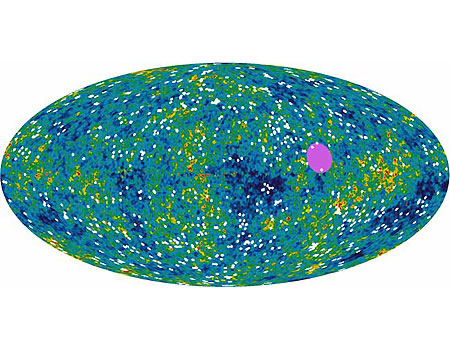
The Daily Galaxy is reporting that scientists have witnessed something as-yet unexplainable called 'Dark Flow'. Apparently, at the outer reaches of the galaxy, where matter is supposed to be heading out in all directions simultaneously, millions of stars are heading toward a single point, a cosmological "hot spot" (Luke McKinney).

It sounds pretty compellingly scary. In fact, so far it has baffled and flummoxed the scientists who discovered it:

The unexplained motion has hundreds of millions of stars dashing towards a certain part of the sky at over eight hundred kilometers per second. Not much speed in cosmic terms, but the preferred direction certainly is: most cosmological models have things moving in all directions equally at the extreme edges of the universe. Something that could make things aim for a specific spot on such a massive scale hasn't been imagined before. The scientists are keeping to the proven astrophysical strategy of calling anything they don't understand "dark", terming the odd motion a "dark flow".


Though we've sort of adopted a (sort of) unifying theory that is an amalgamation of string and supergravity theories, I wonder how this discovery complicates things. The article doesn't go into much depth as to what the Dark Flow might be (just about everything that is not explained is called Dark this or that, these days), nor does the article explain what I've mentioned, which is how it might complicate (and negate some of) the earlier theory.

Perhaps, and I have no idea what I'm talking about, it could be a P-Brane hovering so close to our universe that it is pulling matter toward it. Hmm. I'm no scientist, but it is an interesting concept. I'll try to keep an eye on this to see if there is anything new that comes out of it. Anyone have any thoughts?

Aug 31, 2009

'The Singularity' Trailer - When Will Computers Surpass Human Intelligence?


The trailer posted above is not a documentary about the singularity we all know about - the one that some propose caused the Big Bang - but the length of time it will take for computers to surpass human intelligence. The film is, as of yet, incomplete and is being developed as the money comes in, so the filmmakers are expecting it to be done by the end of the year 2009.

One idea is that, since technological advancement is far exceeding biological evolution, human intelligence will, in the near future, be eclipsed by that of computer intelligence and artificial intelligence.

You can visit the film's web site for more information.

Within the coming decades we will be able to create AIs with greater than human intelligence, bio-engineer our species and re-design matter through nanotechnology. How will these technologies change what it means to be human?

Aug 28, 2009

The First Molecular Photo


The real trouble with small things is they're hard to see, and nearly two hundred years of technological advancement has finally afforded us the opportunity to do more with cameras than upload photos of drunken, naked coeds. As Jack Loftus goes on to write:

That B&W structure is an actual image of a molecule and its atomic bonds. The first of its kind, in fact, and a breakthrough for the crazy IBM scientists in Zurich who spent 20 straight hours staring at the "specimen"—which in this case was a 1.4 nanometer-long pentacene molecule comprised of 22 carbon atoms and 14 hydrogen atoms.

Aug 24, 2009

M87 Black Hole is Big - REALLY Big!


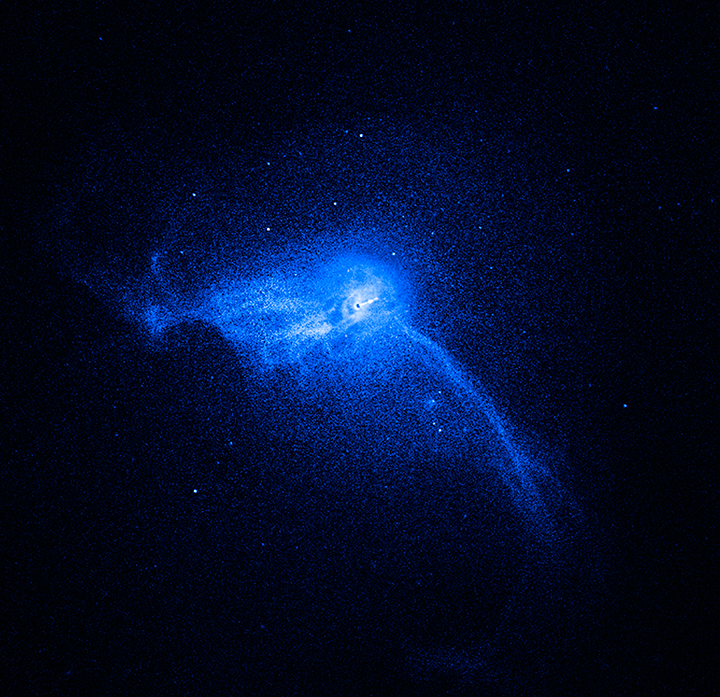
Black holes are generally hard to detect because, well, they are small and the light that might lead us to find them does not escape, and the M87 black hole is no different...except for the fact that it is a MASSIVE black hole. io9 has more to say on the subject:

We've told you before about the black hole at the heart of the M87 galaxy that's brighter than its galaxy... but now scientists have discovered that it may be larger - and more available to us - than originally thought.


Wow.

Jan 23, 2009

The Failure of Science in Public Schools

According to an article in Discover Magazine, as many as 1 in 8 teach Creationism in the classroom as a scientific alternative to evolution, and an astounding 1 in 6 espouse young Earth theories, which state that the Earth is only 6,000 years old. Sheesh.